Tuesday, February 11, 2014

Opera for the Average Idiot #4: Götterdämmerung

aka:

The Ring Cycle: The Conclusion.

Warning:  This is "the long one."  Or rather, "the really long one."  Or as some people know it, "the really really REALLY long one."  I'm about to condense 4 1/2 hours of opera into something more manageable.  Wish me luck. If I'm not back in 5 minutes, just wait longer.

We last left our heroes cursing the Gods, inbreeding (Aunt Brünnhilde and Nephew Siegfried), and generally setting themselves on a course of doom and destruction.

Or as the Norse called it, Ragnarok. (click here for more info on this mythological event)

Prologue
The scene opens with the Norns (daughters of Erda. Kin of like the Fates from Greek mythology.  Kind of.) weaving the rope of destiny as they sit around the rock where Brünnhilde had been laying in her ring of fire.  While they sing of the future, where Wotan burns all of Valhalla to the ground, the rope suddenly breaks.  Disappointed, they leave.


Brünnhilde and Siegfried make their first appearance, after having what we can only assume was copious amounts of sex.  She sends him off to do heroic deeds and asks him to remember their love.  He gives her the ring that he took from Fafnir (see Opera for the Average Idiot #3 for more details) as a token of his love, takes her shield and her horse, and rides off to do herioc type things.

Insert a fabulous orchestral interlude here as we transition to Act I proper.  This is also where we get the "Short Call," which is Siegfried's leitmotif throughout all 4 operas.  Listen for it around the 5 minute, 55 second mark of this video:


Act I

We find ourselves in the hall of the Gibichungs, somewhere near the Rhine river.  King Gunther is confronted by his half-brother, Hagen, who tells him that he (Gunther) needs to find Hagen a wife and their sister Gutrune a husband.  Naturally, Hagen suggests that Brünnhilde would be perfect for him and Siegfried would be perfect for Gutrune.  Why not, right?  We then learn that Gutrune has a love potion that she could use on Siegfried to make him forget all about his pledge of love to Brünnhilde.

Conveniently enough, Siegfried shows up while out and about on his quest to do heroic-type-things.  Gunther extends his hospitality, and his sister, who give Siegfried a drink containing the love potion.  Siegfried toasts to his love for Brünnhilde, drinks the potion, forgets Brünnhilde, and falls madly in love with Gutrune.

(gif source)

Now that Seigfried is single again, he offers to find a wife for his future brother-in-law (Gunther).  Gunther tells him of a maiden asleep, surrounded by a ring of fire that only someone who is fearless can cross (Sound familiar...?).  He and Gunther swear blood brotherhood and head off to find Brünnhilde's rock.  Hagen does not partake of the swearing of blood brotherhood, preferring to remain on guard duty as he sings of how they are unwittingly bringing the Ring to him.

"Myyyyyyy prrrrrreciousssssssss......"
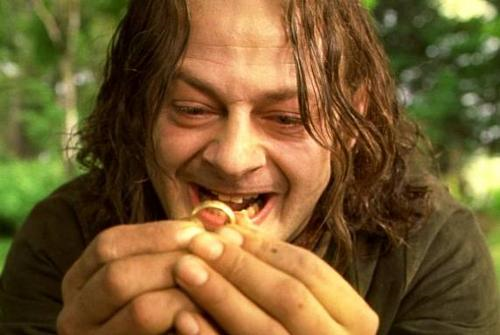

Meanwhile, back at the ranch...
Brünnhilde has a visitor in the form of her sister Waltraute (another Valkyrie), who brings her the news that Wotan has officially given up.  He has barricaded himself inside of Valhalla and is waiting for the end of the world, rather than trying to actually do something about it.

Waltraute asks Brünnhilde to give the Ring back to the Rhinemaidens (remember Das Rheingold from way back when?) to end the madness.  Being the selfish thing that she is, Brünnhilde refuses to give up the Ring since her Siggy gave it to her as a token of his love.  Waltraute gives up and leaves.  Enter Siegfried wearing the Tarnhelm, which makes him look like Gunther.  He (as Gunther) claims her as his wife and she fights him because she is still in love with Siegfried.  He tackles her, takes the Ring from her, and places it on his own finger.

Act II
This act returns us to the land of the Gibichungs where we find Hagen by the Rhine.  He is suddenly visited by his father, who is, surprisingly, the dwarf Alberich!!! We thought we had left this bastard behind in Das Rheingold, but nooooooooooooooo.....that would be too easy.  You guessed it, he's still after the Ring and he gets his son to swear that he will kill our hero and get the ring back for his father. Siegfried, Gunther, and Brünnhilde return and Brünnhilde is shocked to see that Siegfried is wearing the Ring, not Gunther who she had heretofore thought was the one who conquered her.

Brünnhilde to Siegfried: "You seduced and betrayed me!!"
S to B: "Did not!"
B to S: "Did too!"
S to B: "Did not!"
B to S: "Did too!"
S to B: "I swear on this spear that Hagen is conveniently holding, that I did not!"
B to S: "I swear on the same spear that Hagen is conveniently holding that you did!"

Unbeknownst to us, but knownst to our heroes, if an oath is sworn upon a weapon and the oath is broken, the owner of the weapon must kill the person who broke the oath.

Hellooooooooo foreshadowing.....

Siegfried heads off to the wedding feast with Gutrune.  Gunther agrees with Hagen that Siegfried must die for the insult he has given to Brünnhilde.  Brünnhilde is pretty damn pissed off at her former beau by now and she reveals to the conspirators that they can kill Siegfried if they stab him in the back.

Act III
subtitled:
DEATH!!! DOOM!!! DESTRUCTION!!!

We return to the banks of the Rhine where the Rhinemaidens are still mourning the loss of the Rhinegold (yes, three operas later, they are still in mourning).  Siegfried walks by after being separated from a hunting party and they beg him to return the Ring. He refuses and tells them that he would rather die than give it up.

Oh look....our good friend foreshadowing...nice to see you again....

(gif source)
Siegfried rejoins the hunters and starts telling stories of his childhood while everyone rests by the river.  Hagen gives him a drink containing a potion that restores his memories and he tells the tale of how he found Brünnhilde and woke her with a kiss.  Suddenly, Wotan's ravens do a fly-over, distracting Siegfried long enough for Hagen to stab him in the back.  Remember that Siegfried swore on Hagen's spear in Act II that he did not seduce/betray Brünnhilde.  Hagen was honor-bound to kill him for breaking that oath.  The hunting party carries Siegfried in a funeral procession back to the Gibichung Hall.

(scene dissolve)

The procession arrives at the Gibichung Hall where Gutrune is waiting for Siegfried.  Gunther blames Hagen for Siegfried's death.

Hagen defends his actions by reminding everyone of Siegfried's broken oath and he claims the Ring by right of conquest.  Gunther tries to stop him but Hagen attacks and kills his brother easily.  Hagen goes to take the Ring and Siegfried's hand moves in a threatening manner.  Hagen is startled and Gutrune dies.  Why not, right?

Brünnhilde makes a sufficiently dramatic entrance and orders a funeral pyre to be built by the river.  She then takes the ring from Siegfried's hand and summons the Rhinemaidens.  She tells them to take the Ring from her ashes when she is gone as the fire should cleanse the Ring of the curse.  Her final act is to send Wotan's ravens to Valhalla with a message of their impending doom.  She mounts her horse, Grane, and rides into her own funeral pyre.

I give you.....the end of the world.

The Gibichung Hall burns down.  The Rhine overflows.  The Rhinemaidens take back the Ring.  Hagen decides to be a complete idiot and goes after the Rhinemaidens to get the Ring.  They drown him.  There was much rejoicing from the Rhinemaidens (yay!).  The scene closes as we see Valhalla glowing brightly in the distance as all of the Gods are burnt to a crisp.

The End


Congratulations!!! You made it to the end!  I suppose I could have saved you even more time by simply saying that everyone dies at the end, but where would the fun be in that?? 

(gif source)

(gif source)
Now, if you don't mind, I think I have earned a drink after this one.

Friday, January 24, 2014

Slate.com article: My Response

 As I'm sure many of you are at this point aware, there was a rather ill-informed and offensive article posted on slate.com earlier this week stating that "classical music is dead."  (Click here to read the full article on slate.com)  I have been contemplating a response to the the author's comments for a few days but was having a difficult time moving beyond the extreme anger inspired by the article in order to formulate coherent thoughts on the subject.  And I was also trying to avoid resorting to simply calling the author a "jerk-face" or "ass-hat."  You know, at least make it somewhat apparent that at one point in my life I graduated Summa Cum Laude and earned a Master's degree.

Luckily, another blogger (Andy Doe, of properdischord.com.  I very highly recommend following him) took it upon himself to write a response that gave a voice to my thoughts and feelings beautifully.

PLEASE go here to read Andy's spectacular response to the the offending piece.

There's only one thing I would add as a response to the author of the Slate.com article:  Thank you.  Thank you for so blatantly offending me and bashing what I do for a living.  I really appreciate how easy you found it to declare classical music to be dead when most of your cited facts either supported the idea that support for classical music is increasing, or they came from looking at the number of "likes" on Facebook.  Last time I checked, Facebook is not a viable source of unbiased information, nor is it likely to represent a sufficiently diverse enough population to give much credibility to the number of "likes" actually counting as an unbiased survey.  Thank you for insulting how I have spent the last 20 years of my life and for declaring those 20 years to essentially be a waste of my time.  Thank you for being so willing to assume that classical music has no place in the world of today.  You all too easily declare that it belongs only to the elderly, yet here I am, under the age of 30 and completely in love with performing and listening to music from over 100 years ago.  I definitely find it preferable to most of the disposable crap that's being produced today.  Classical music will never die as long as we are here to fight you for it.  Arts funding will never disappear as long as we fight for it.  Orchestras will never die as long as we fight for them.  It is clear that you do not care for classical music yourself and therefore have no problem with writing it off as deceased.  Be sure that you do not mistake your own opinion for fact, and the fact is, classical music is not dead.  And as long as I have breath in my body to fight for it, it never will be.

Wednesday, January 15, 2014

Tonguing. Just Do It!

I apologize ahead of time if this post comes across as more than mildly frustrated...

I'm finding more and more that there are far too many high school horn players that have no idea how to articulate anything other than a slur. They use a "huh" attack on anything that does not have a slur marked on it, and they think that this is correct.  Some of them are even proud of their so-called ability to articulate in this manner.  Are they really not taught how to tongue properly before they reach their high school years?  Being married to a band director places me in a position where I am fully aware that we absolutely cannot hold band and orchestra directors solely responsible for this problem.  When you have 70+ students all playing different instruments at the same time, it's impossible to correct every single technique issue that may arise with your students.  If the student doesn't make it glaringly obvious in rehearsal, they can glide through 4 years of high school and their teacher could never know there was a problem.  There comes a point where you have to trust that your students are retaining at least some of the information that you try to impart to them each day.  That being said, there is a distinct difference between knowing how to tongue and choosing to not do so properly (i.e. laziness) and actually not knowing how to tongue.

Correct me if I'm wrong, but I have always been under the impression that tonguing is one of the most basic skills that is required of wind instrumentalists (brass and woodwind alike).  Air, buzz, tongue.  Our primary tools.  Whilst on my eternal mission to get my students to practice their fundamentals, I have been compiling the following mental list of ways to help them articulate:

-  Say "tah" into the horn while you play (I know, "Thank you Captain Obvious." Right?  I'm surprised just how many students cannot do this.)
-  Play a whole note.  Follow it with 4 straight quarter notes using the same air stream as the whole note.  Simply interrupt the whole note with the tongue to create the quarter notes.
-  Pretend to spit out watermelon/pumpkin/sunflower seeds.  Actually spit out watermelon/pumpkin/sunflower seeds.  Apply the same technique to playing.

-  Pick a pitch.  Play it as short as humanly possible at a loud dynamic.  Keeping the note short makes it nearly impossible to start the pitch without the tongue in addition to not allowing time for pitch manipulation.  This can help with pitch accuracy as well if you move around to different pitches.
-  Do the same thing but as softly as possible.
-  Tell them to spit tacks.
-  Don't let them do anything aside from articulation exercises in their lessons for weeks.  They'll do anything to move on to something new.

My request, as a friendly neighborhood private instructor, is that we don't allow our students to "get by" with lazy or lousy tongue technique.  It is a fairly simple concept that can be taught when they are young.  The older your students get, the harder it is to unlearn bad habits.  Especially if they are not often corrected on it.  Demonstrate proper tonguing often and bring it to your students' attention. Emulation is one of my favorite teaching tools with my younger students.  They don't need to think about how to do something.  They can copy anything you do if they just know what they are listening for.

Monday, December 16, 2013

Cross Training

The busy holiday season has struck once again.  Between all of the gigs, the baking, the ugly sweater parties, and the traveling, we still somehow have to find time to practice.  The gigs will certainly help keep us in shape, but since it is rare that those are our only obligations, we are forced to find creative ways to squeeze productive practicing into our busy schedules.  Whether it be from lack of endurance, lack of time, or neighbors who do not appreciate you playing through Mahler 3 at 11:00 at night, there are any number of reasons why we may not be able to practice according to our usual routines.  And let's face it, sometimes we just need a day off from playing to let our bodies rest.  It is times like these that I am a particular fan of productive practicing without playing the instrument itself.

Finger/Air the Music
Much of the time that we spend cleaning technical passages is devoted to coordinating our fingers with our tongues.  Finger through these passages without playing in order to listen for your coordination.  Listen for clean valve changes without being distracted by your sound from the bell.  Finger through while airing the part to improve coordination between fingers and tongue.  There is no need to waste precious endurance when much of your work can be done silently.

Sing/Buzz
Sing or buzz through your parts to ensure that you are hearing the correct pitches and intervals.  Many times when we miss something it is a result of not being able to hear the pitch properly in relation to the surrounding pitches.  If you can sing and/or buzz it (and you're using the correct fingerings/technique), you should have little trouble playing it.

Listen
Take the time to listen to recordings.  Turn on your favorite recordings when you're driving from one party to another and sing along with them (yes, without words).  Familiarity with a work can remove much of the frustration associated with learning something new.  Even if you cannot listen to a specific piece on which you are working, listen to other works by the same composer or another composer of similar compositional style.  Combine listening with a little score study to really maximize your productivity (not while driving, of course).

Practicing tonguing
Practice your multiple tonguing as you walk around.  Many of our coordination issues without "t's" and "k's" are best improved upon away from the instrument anyway.  If your tongue gets tied in knots while double tongue a string of 8th notes on a single pitch, go back to the basics.  Take things slowly and work with just your tongue and a metronome without complicating things by adding an instrument into the mix.

Do nothing
Give your ears, mind, fingers, and body a break.  Instead, read a book, watch a movie, learn to knit, pet a kitty, do yoga, meditate, take a nap, meet a friend for coffee, go for a drive.  Do ANYTHING but think about playing.  We can be so busy and driven that it's easy for us to forget to chill every now and then.  If you don't have time to practice, maybe it's a good time to take a break anyway.  Warm up as you need to in the morning, play your jobs as required, and put the instrument away long enough to recharge your batteries a little.

Read
Take a few minutes to catch up on the latest Horn Call, or another music journal, to see what you've been missing in the horn world.  You may learn something new, or at the very least be reminded of a technique or exercise that you can use in your own playing.

Blog
Writing here is one of the ways that keep myself honest with my playing.  If I have the audacity to advise others to do something, it would be awfully hypocritical of me to not follow my own advice.  Sometimes I realize that I need a little reminder myself and writing it down makes it seem as though the words are coming from an external source.  It's harder to ignore your nagging shoulder angel when anyone can read about it.

Saturday, November 30, 2013

Victory

When, in one practice session, you conquer both Beethoven 7 and the Long Call in one shot:


Friday, November 15, 2013

Remembering to Sing

The last few months I've been spending a rather extensive amount of time working on solos and excerpts for upcoming DMA auditions.  Most of the works (all but 1 excerpt to be exact) are from principal parts, directed toward principal players.  This has been mildly problematic for me over the last few weeks considering the fact that I am primarily a low horn specialist.  Yes, we all have to be able to play the full range of the instrument, and yes, I do still need to be able to play all of the excerpts, but some players are built to be principal players full time whereas I most definitely am not.  I am happy to play Don Quixote or Shostakovich 5 all day, every day with no complaints whatsoever.  To give a running comparison, some players are meant to be sprinters (high hornists) and others are meant to run marathons (low hornists).  Sprinters still have to work on their endurance and marathoners have to run sprints to maintain balance in their training.  However, both types of runners still manage to maintain their focus on their individual strengths instead of trying to fit into the mold of being something that they are not.  I had somehow allowed myself to fall into the trap of being a marathoner who was working on her sprints 100% of the time. 

It was actually a colleague of mine who pointed this out to me after I had broached the subject of the frustration that has been building since starting my full-time work on my audition music.  Remembering where your strengths lie is such a simple idea and I had allowed my focus and drive to blind me from it.  The need for technical and mechanical perfection had completely over-ridden the ability to hear and cultivate a beautiful, characteristic, horn sound.  Basically, I had forgotten how to sing.

I mean this in both the literal sense of using my voice to sing as well as the figurative voice that we use to sing through our instruments.  As I drove home after the aforementioned conversation, I realized that I could not remember the last time that I sang along with the radio at the top of my lungs.  My primary source of inspiration for playing a beautiful melody is opera, especially arias in the bel canto style.  While I am certainly not an opera singer myself, I can belt out show tunes with the best of them.  I used to always be singing along with Beauty and the Beast, The Phantom of the Opera, Wicked, or Ragtime, to name a few.  I started singing along with Phantom and was quickly reminded of just how much singing can help your breath support, phrasing, style, vibrato, and so on.  It felt fantastic and it was extremely liberating to rediscover this part of my voice.

The focus on principal solos and excerpts had consumed my practice sessions to the point where I would literally play nothing else outside of my warm-up routine.  It was a much needed reminder that the ultimate reason why we play this instrument is the beautiful sound, not the technical aspects of performance.  I needed to rediscover the sound that I loved.  It was time to slow down on the long tone exercises and use them to perfect my tone rather than as a launch pad to more technical exercises.  Milk the Arnold Jacob "Beautiful Music" exercise for all that it is worth (many thanks, my tuba playing friends).  Play through some of the big movie themes (i.e. Star Wars, Star Trek - new one, Star Trek: First Contact, Jurassic Park, etc.).  I had a particularly splendid time reading through the Rochut trombone Melodious Etudes books as well as the Shoemaker Legato Etudes based on Concone's Vocalises and the back section of the Arban's book for trumpet.  It was an extremely pleasant way to remember why I love to play in the first play.  Air was moving, my sound was returning, and both physical and mental stiffness finally relaxed.

The ultimate lesson that I received from all of this was to remember that there is always time to remember why you play.  No matter how soon or how far away an audition may be, you cannot forget to work on your sound.  The required music will always work as long as you love what you do.  Stiffness, anger, and frustration are some of the biggest barriers that you can face on the road to an audition and you have the power to do something about them.  Trust yourself.  Trust your horn.  Trust your heart.  There is always the time to play something simply for the sake of making music.

Monday, November 11, 2013

Transposition

When you get a part for horn in E, and someone penciled in the wrong transposition through the entire piece...